
Epoxy Floor Maintenance and Cleaning: How to Extend Its Service Life
An epoxy floor needs little maintenance, but it should not be neglected. Everything you need to know, from daily cleaning and stain removal to the…
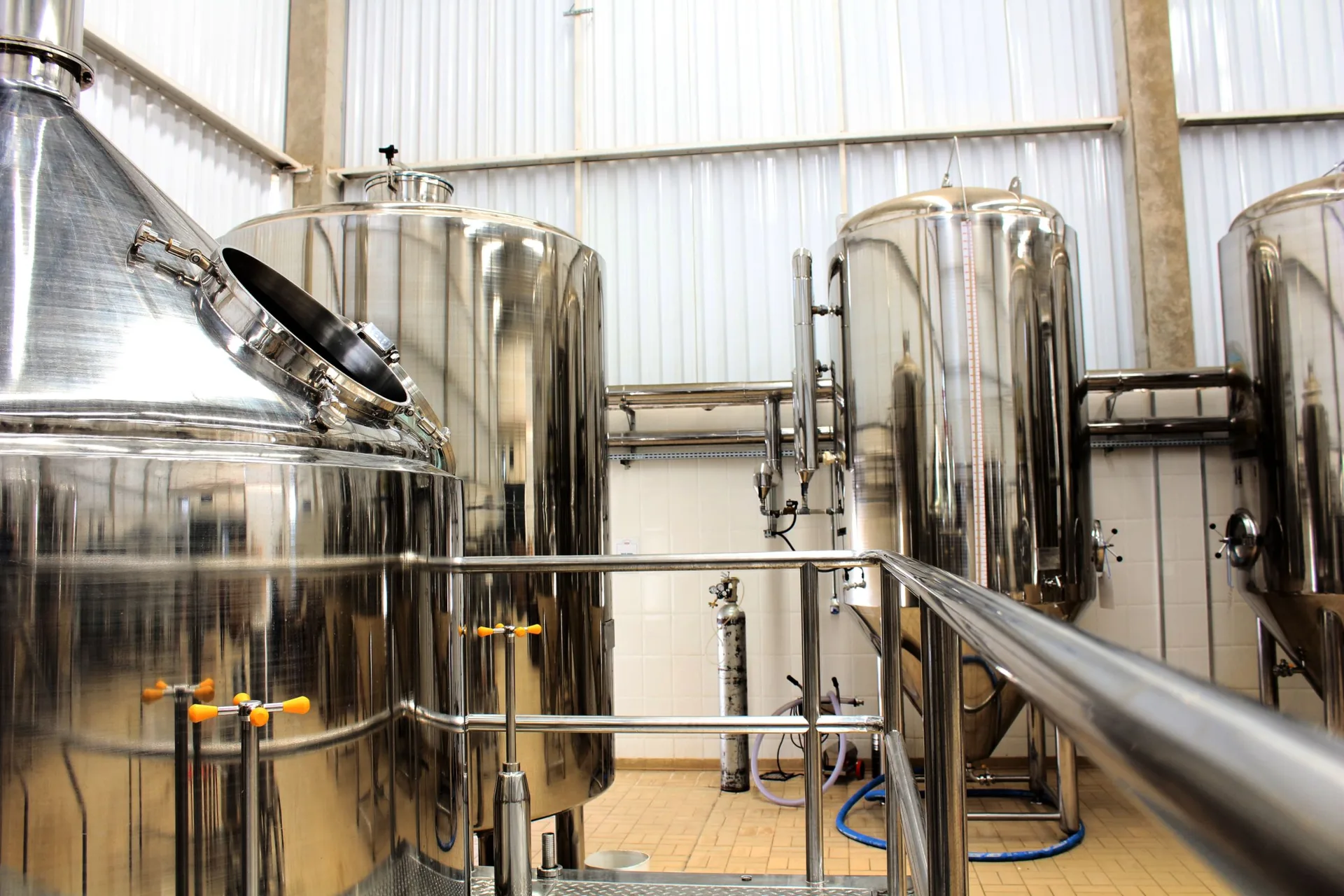
Seamless epoxy flooring systems for the indoor areas of chemical plants, petrochemical facilities and energy facilities, selected according to the chemicals spilled, forklift traffic and static electricity risk.
Chemical plant epoxy flooring, like epoxy flooring in energy facilities, covers the concrete with a seamless, impermeable layer that stops spilled liquids from soaking into the floor and makes cleaning easier. Chemical resistance is not the same for every product and every concentration, so the system is selected according to the list of chemicals used at the facility. In sections where flammable vapor or dust is present, anti-static epoxy is applied to conduct static electricity to ground.
In chemical plant epoxy flooring and energy facility flooring work, the floor's job is not just to carry loads. The floor must stop spilled liquids from soaking into the concrete, make leaks visible, be easy to wash down and, in some sections, conduct static electricity safely to ground. Bare concrete can do none of these things: it is porous, it absorbs spilled liquids, its surface dissolves on contact with acid and, over time, it starts to dust.
A chemical that soaks into concrete does more than leave a stain. Acids dissolve the cement paste, oils and solvents travel deep into the concrete, and chloride solutions can reach the reinforcement and start corrosion. What is more, the absorbed liquid cannot be cleaned out; it returns to the environment as odor and vapor. With jointed tile coverings, the weak point is the joint: even if the tile holds up, the grout wears away and liquid passes beneath the covering.
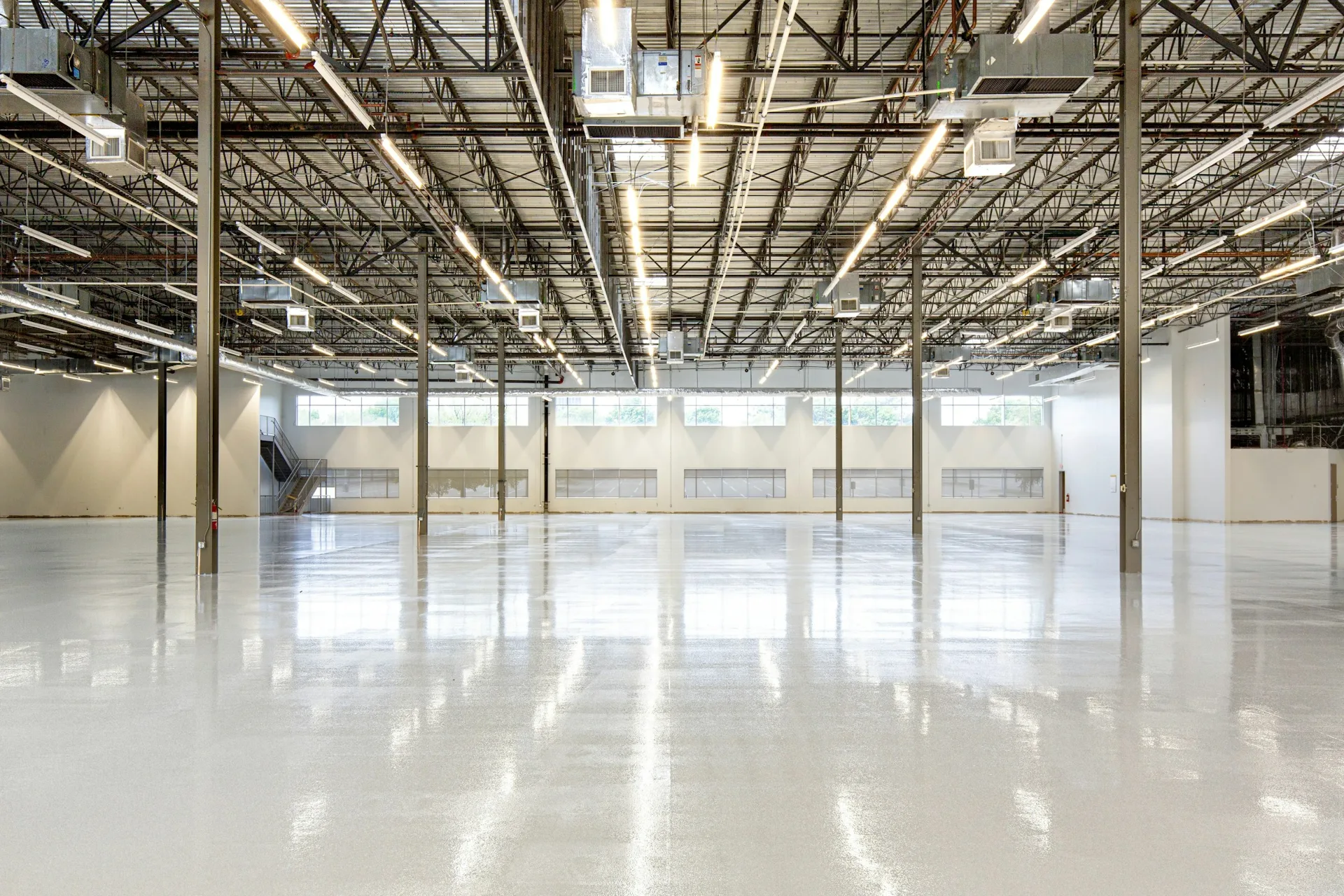
An epoxy coating forms a seamless, impermeable layer over the concrete. Spilled liquid stays on the surface, is noticed and is wiped away. On a light-colored floor, a dripping valve or a leaking flange catches the eye immediately, which makes the maintenance team's job easier. Because the surface does not dust, no concrete dust settles on measuring instruments, panels or the product.
Even so, not every epoxy resists every chemical, and there are conditions in which epoxy is not the right choice. On this page we explain plainly which system works in which section, where it falls short and what information we ask you for before quoting.
The sentence "epoxy is resistant to chemicals" is incomplete on its own. Resistance depends on the formulation of the epoxy product and on what the chemical in contact with it is, and at what concentration and temperature it is present. A coating that resists a dilute solution of an acid for a long time may discolor, soften or blister in a short time when it meets the same acid in concentrated form. For this reason we do not generalize.
The list of chemicals in use is requested at the quotation stage. We compare the list, item by item, with the chemical resistance chart published by the manufacturer of the material we are considering applying. The assessment looks at the following information:
If the list contains a substance the coating cannot withstand, we state this plainly in the quote. For some concentrated acids, strong solvents or continuous contact with hot liquids, epoxy may not be the right choice. Rather than coating such a section and leaving the problem for later, we recommend keeping that section out of the scope.
Within the same facility there are floor conditions that differ greatly from one another: one section may have solvent vapor, while the room next to it has nothing but foot traffic. Below we deal separately with the types of area we work in most often and with what stresses the floor in each of them.
In chemical plants that produce paint, detergent, adhesives, fertilizer or cosmetic raw materials, the floor faces splashes around reactors and mixers, drips on the filling lines and forklifts carrying raw materials, all at the same time. In the production hall, 2–3 mm self-leveling epoxy is usually applied; the smooth surface makes it easier to wipe up spilled liquid. In filling and washing sections where the floor is washed often or stays constantly wet, textured epoxy reduces the risk of slipping. Powder and granules spilled at the raw material weighing and feeding points also abrade the floor; in these zones it matters that the surface can be swept easily.
The details to watch are reactor legs, machine plinths, floor drains and channel edges; it is mostly through these junctions that liquid reaches the concrete. In sections where flammable raw materials are processed in powder form or where solvent vapor forms, whether an anti-static system is required is determined by the facility's own risk assessment. You can find broader information on general production areas on our factory epoxy flooring page.
In petrochemical facilities the process units are mostly outdoors, and these areas are not suitable for epoxy: direct sun, rain and large temperature swings wear the coating out in a short time. The places where epoxy does its job are the enclosed spaces: control rooms, quality control laboratories, enclosed pump and compressor buildings, maintenance workshops, and spare parts and additive stores.
In these sections the floor is stressed by hydrocarbons, lubricating oils and solvents; which product is present at which concentration is checked against the list. In enclosed spaces where flammable vapor may be present, a conductive anti-static floor is chosen to reduce the risk of a spark arising from static discharge. In control rooms, a smooth surface that does not dust and wipes clean easily is sufficient. The floor beneath hot-surface equipment and the points where steam lines discharge are assessed separately; continuous high temperature exceeds the limits of epoxy. For laboratory floors, the information on our hospital and laboratory flooring page is also a useful guide.
At fuel facilities we recommend epoxy only for enclosed indoor areas: pump rooms, the oil and additive store, the maintenance workshop, and the archive and office sections. The open yard and the fueling islands are outside this scope. On an outdoor surface exposed to sun, rain, frost and constant vehicle traffic, epoxy is not the right choice; we state this plainly at the quotation stage.
In the pump room the floor is exposed to dripping fuel and oil; the seamless surface stops spilled fuel from soaking into the concrete and makes cleaning easier. In enclosed spaces where flammable vapor can accumulate, the floor is built with an anti-static system and connected to the grounding line. In the store and the workshop, self-leveling epoxy is used, and if traffic is light, epoxy floor paint is sufficient. In the office and staff sections, what is expected is a plain surface that does not dust and wipes clean easily. Wiping up spilled fuel quickly instead of leaving it to pond extends the life of the coating noticeably.
In power plants, floor conditions change from section to section. In turbine and generator buildings, the floor is stressed by leaks of lubricating oil and hydraulic oil, the wheel loads of heavy maintenance equipment and dropped hand tools. In battery rooms there is dripping electrolyte, and in the water treatment and chemical dosing sections there are acid and alkali solutions; here too, the product and concentration information is decisive.
In control rooms, electrical panel rooms and cable galleries, the expectation is a surface that does not dust, is easy to clean and improves the lighting; in these sections epoxy floor paint is usually sufficient. Self-leveling epoxy is preferred in the turbine hall and the workshop, and textured epoxy in pump houses that are constantly wet. The operations buildings and storerooms of solar, wind and hydroelectric power plants are handled on the same reasoning. Whether the floor in panel and switchgear rooms needs to be conductive or insulating is defined in the facility's electrical design; an anti-static floor is not the right choice for every electrical room.
In battery manufacturing plants the floor has to meet three separate expectations at once: cleanliness, chemical resistance and static control. In the electrode preparation and cell assembly sections, dust directly affects product quality; this is why a seamless, dust-free self-leveling surface is preferred. In sections where electrolyte filling takes place there is a risk of spills, and the composition of the electrolyte varies with the type of battery: an acid solution is used in lead-acid batteries and a solvent-based electrolyte in lithium-ion cells. The coating is selected according to the type and concentration of this liquid.
In assembly and test areas where cells and electronic boards can be affected by static discharge, anti-static epoxy is applied and resistance is measured at handover. In the charging and formation sections, the rack legs and the vehicle routes are separated by clearly visible lines. In low-humidity dry rooms, the application schedule is placed in the period before the room is commissioned, because the area must stay closed to production throughout coating and curing.
In chemical storage areas the floor's main job is to hold the liquid spilled from an overturned drum or a punctured IBC tank without letting it pass into the concrete. For this reason the coating is not confined to the flat floor; the floors of the spill containment basins, the curbs and the base of the walls are also coated with the same system without a break. The joints and the lines where wall and floor meet are the weakest points, and they are carefully filled and sealed.
If acids, alkalis and solvents are kept in separate compartments in the store, each compartment is assessed according to its own chemical; the compartments can be coded in different colors. Self-leveling epoxy is chosen in aisles where drums are moved by forklift and pallet truck, and a textured finish on ramps and at entrances that get wet. In enclosed spaces where flammable liquids are stored, an anti-static floor comes into consideration. Liquid that stands for a long time in a containment basin is a far more severe condition than a short-lived splash; spilled liquid needs to be drained without delay. For rack layout and traffic planning, you can also take a look at our warehouse epoxy flooring page.
The system is selected according to the section's chemical load, how wet it gets, its traffic and its explosion risk. In the same facility, more than one system is usually used side by side, and the transitions are placed at door thresholds or along joint lines.
The shoe of a worker walking, a turning wheel, even liquid being transferred from one container to another builds up static charge on surfaces. On an insulating floor this charge finds nowhere to go and is released all at once. In an environment containing solvent vapor, flammable gas or fine dust suspended in the air, this discharge can be a source of ignition.
In an anti-static system, copper tapes are bonded over the primer in a grid pattern and connected to the building's grounding line. A carbon-filled conductive primer is applied over them, and a conductive self-leveling coat over that. In this way the charge flows to the floor, and from there to ground, before it can build up. In areas with an explosion risk, the conductive type that discharges the charge quickly (approximately 10⁴–10⁶ Ω) is preferred; the target value is determined together with you according to the facility's own standard. After curing, the surface resistance is measured and the measurement record is handed over.
The floor is only one part of static control. Workers need to wear shoes with conductive soles, and the equipment, drums and transfer containers need to be grounded; otherwise the charge cannot reach the floor. We do not decide whether a section counts as an explosive atmosphere. That classification is set out in the facility's explosion protection document; we install the floor to the requirement defined in that document.
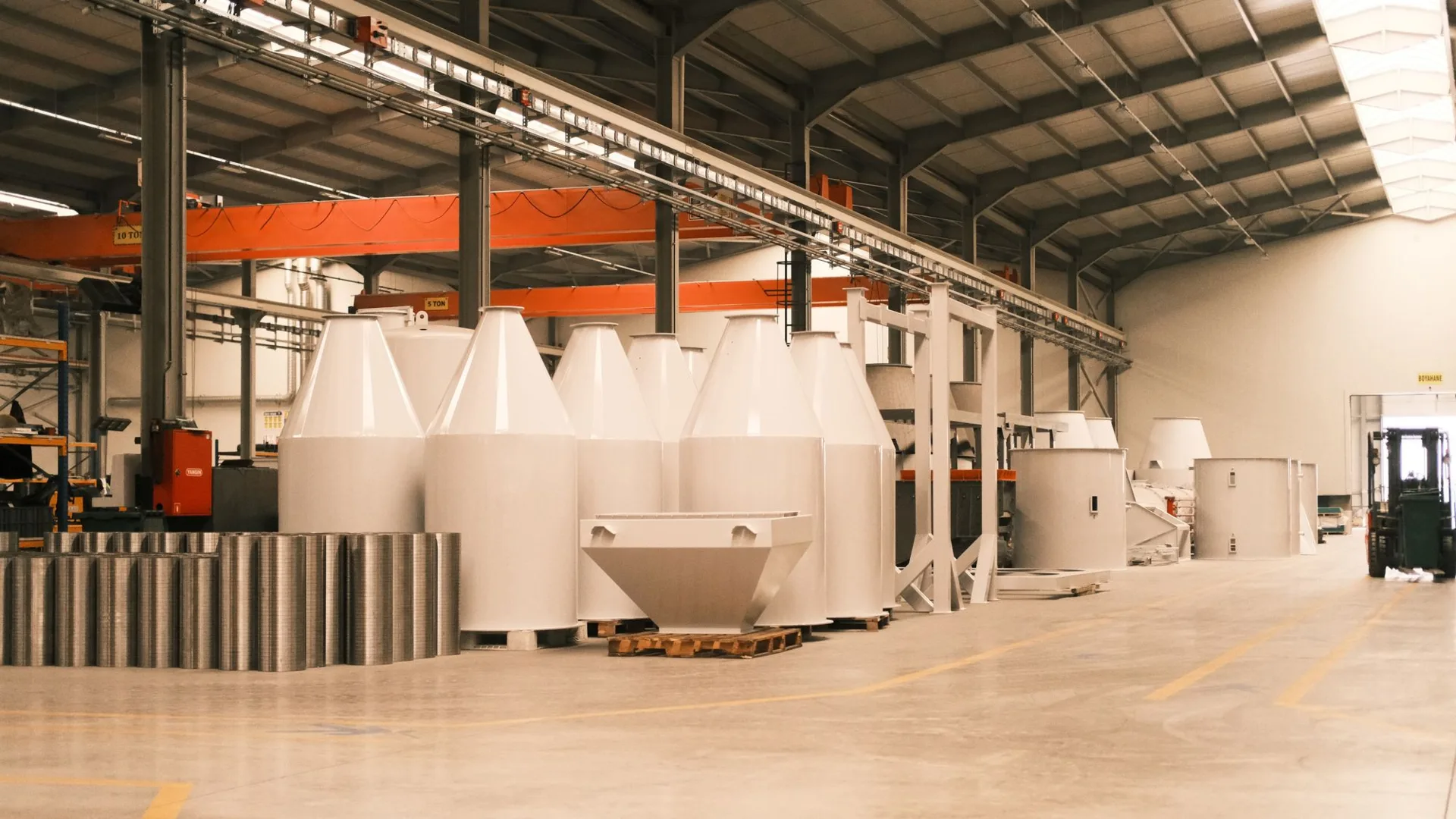
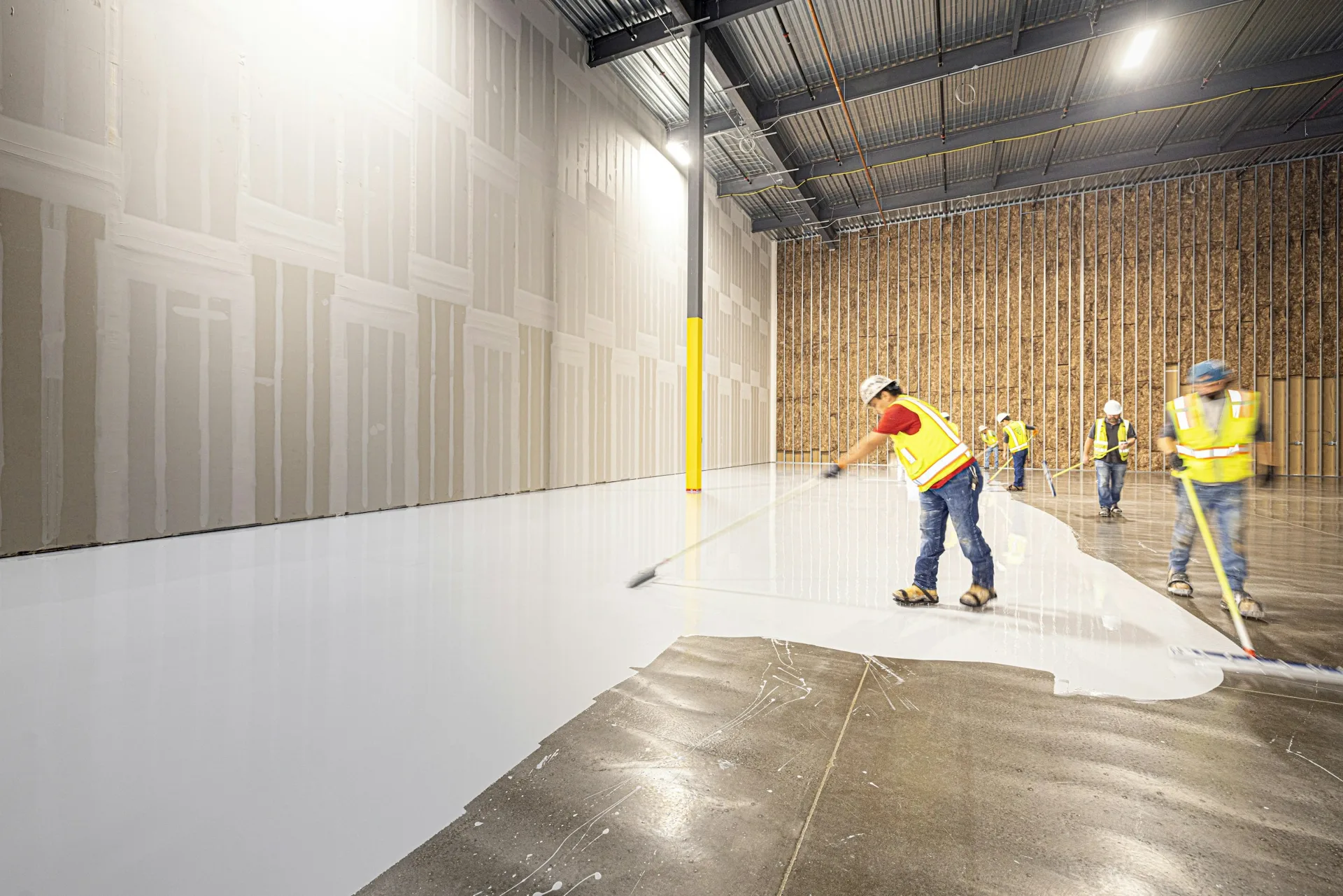
In chemical plants and energy facilities, stopping production for the floor alone is usually not possible. That is why we recommend timing the work to coincide with planned maintenance shutdowns, or dividing the area into sections and coating them in turn. While one section cures, the section next to it carries on working; passageways and emergency exits are kept open in every phase.
The machines used for surface preparation run on electricity and produce dust. In sections where flammable vapor may be present, this work begins only after the area has been emptied and ventilated and the facility's work permit process has been completed. Our crew complies with the facility's occupational safety rules and its permit-to-work system; when preparing the schedule we factor in these approval times as well.
Self-leveling systems contain no solvent and their odor is limited; even so, ventilation is kept on throughout curing. Curing takes longer at low temperatures, so in unheated spaces in the winter months the durations are planned accordingly. The point most often overlooked is chemical contact: even though the floor can be walked on the next day, the seven-day cure must be complete before the tanks are filled and the filling line is started up.
In this sector the first rule of maintenance is not to let a spilled chemical sit on the floor. The spill is collected with absorbent material in line with the facility's own response procedure, and then the surface is rinsed with plenty of water. Even when the coating has been selected to resist the chemical, the shorter the contact time, the longer its life.
Neutral detergents that leave no residue are used for daily cleaning. Smooth surfaces are cleaned with a floor scrubber or a mop, and textured surfaces with a scrubber fitted with brushes. Polish and wax are not applied to anti-static floors.
The floor should be inspected visually at regular intervals. Discoloration, dulling, softening or blistering is an early sign that the coating is being affected by a chemical; a local repair carried out at this stage prevents damage to the concrete. Joint sealants and the areas around floor drains are reviewed in the same inspection. On anti-static floors, measuring the resistance again from time to time confirms that the system is working. Not dragging drums and not using carts with metal wheels also protects the surface.
For a daily, weekly and yearly maintenance schedule and cleaning tips for each type of stain, see our guide Epoxy Floor Maintenance and Cleaning.
In chemical plants and energy facilities, cost is determined by the conditions rather than by the square meters. When preparing the quote we look at the following items:
We explain what to look for when comparing quotes in our article 7 Factors That Determine the Cost of Epoxy Flooring per m².
So that we can recommend the right system, including the following information when you fill in the quote request form makes our work easier: the type of facility and the sections to be coated, the approximate area in square meters, the condition of the existing floor, the name, concentration and temperature of the chemicals in use, how often the floor gets wet, forklift or pallet truck traffic and, if any, the zones classified as explosive atmospheres. If you also share the planned shutdown dates and a few photos, we can make the initial assessment more quickly.
With this information we prepare our written quote, which contains a system recommendation for each section; once the quote is approved, we carry out a site survey and measurement. You can review the details of the systems we install on the services page and the other industries on the sectors page, and for questions you can reach us through the contact page.
| Recommended system | 2–3 mm self-leveling; 3–5 mm textured in wet sections; anti-static epoxy in explosive atmospheres |
|---|---|
| Chemical resistance | Assessed according to product, concentration, temperature and contact time |
| Surface preparation | Diamond grinding or shot blasting; removal of oil and chemical residue |
| Concrete condition | At least 28 days old, moisture content below 4% |
| Open to foot traffic | Approx. 24 hours |
| Open to chemical contact | After full cure (7 days at 20 °C) |
| Handover in anti-static sections | With a resistance measurement record |
No, resistance varies with the epoxy product used and with the type of chemical, its concentration, its temperature and how long it stays on the floor. A coating that resists a dilute solution without any problem may be affected by the concentrated form of the same substance. That is why, at the quotation stage, we ask for the list of chemicals used at the facility and compare it with the material manufacturer's resistance chart. If there is a substance that does not appear suitable, we notify you of this in writing.
In these sections, anti-static epoxy that conducts static charge to ground is applied. The system consists of copper tapes, a conductive primer and a conductive self-leveling coat, and it is connected to the building's grounding line. In areas with an explosion risk, the conductive type that discharges the charge quickly is chosen, and when the work is finished the surface resistance is measured and recorded. Which section is an explosive atmosphere is defined in the facility's explosion protection document; the floor alone is not considered sufficient, and conductive footwear and equipment grounding are also required.
No, we do not recommend epoxy for open yards and fueling islands. Epoxy yellows and chalks in direct sunlight, and on an outdoor surface exposed to rain, frost and uninterrupted vehicle traffic it does not deliver the expected service life. At fuel facilities we apply epoxy in enclosed indoor areas such as the pump room, the oil store, the workshop and the office. In enclosed spaces where flammable vapor can accumulate, an anti-static system is preferred.
For chemical contact, full cure must be awaited; this takes 7 days at an ambient temperature of 20 °C. The floor can be walked on after about 24 hours, but at that stage its chemical resistance is not yet complete. Early contact can lead to permanent staining and softening. Because curing takes longer at low temperatures, in unheated spaces in the winter months the commissioning date is planned accordingly.
It can, but the contaminated layer has to be removed first. An oil-soaked surface is washed with special cleaners, the loose layer degraded by acid is scraped away down to sound concrete, and the surface is opened up by diamond grinding or shot blasting. If the contamination has gone very deep, the concrete in that zone is broken out and renewed. A primer applied without this preparation cannot bond to the concrete, and the coating lifts in a short time.
Yes, the floors, curbs and inner surfaces of spill containment basins in enclosed areas can be coated with the same system as the floor, without a break. In this way spilled liquid is held in the basin without passing into the concrete. What is decisive here is the type and concentration of the liquid to be held in the basin; liquid that stands for a long time is a far more severe condition than a short-lived splash. For this reason the basin needs to be drained without delay after a spill and the surface rinsed.
An epoxy floor needs little maintenance, but it should not be neglected. Everything you need to know, from daily cleaning and stain removal to the…
Our priority is
Tell us about your project, and together we will pin down the right epoxy system for your floor, the application time and our quote.
Get a Quote5-year workmanship and 10-year product warranty. We respond to all requests within 24 hours. We work in all 81 provinces.