
What Is Epoxy Flooring? Types, Benefits and Applications
We explain in plain language what epoxy flooring is, which types are available and why it is chosen for different kinds of spaces.
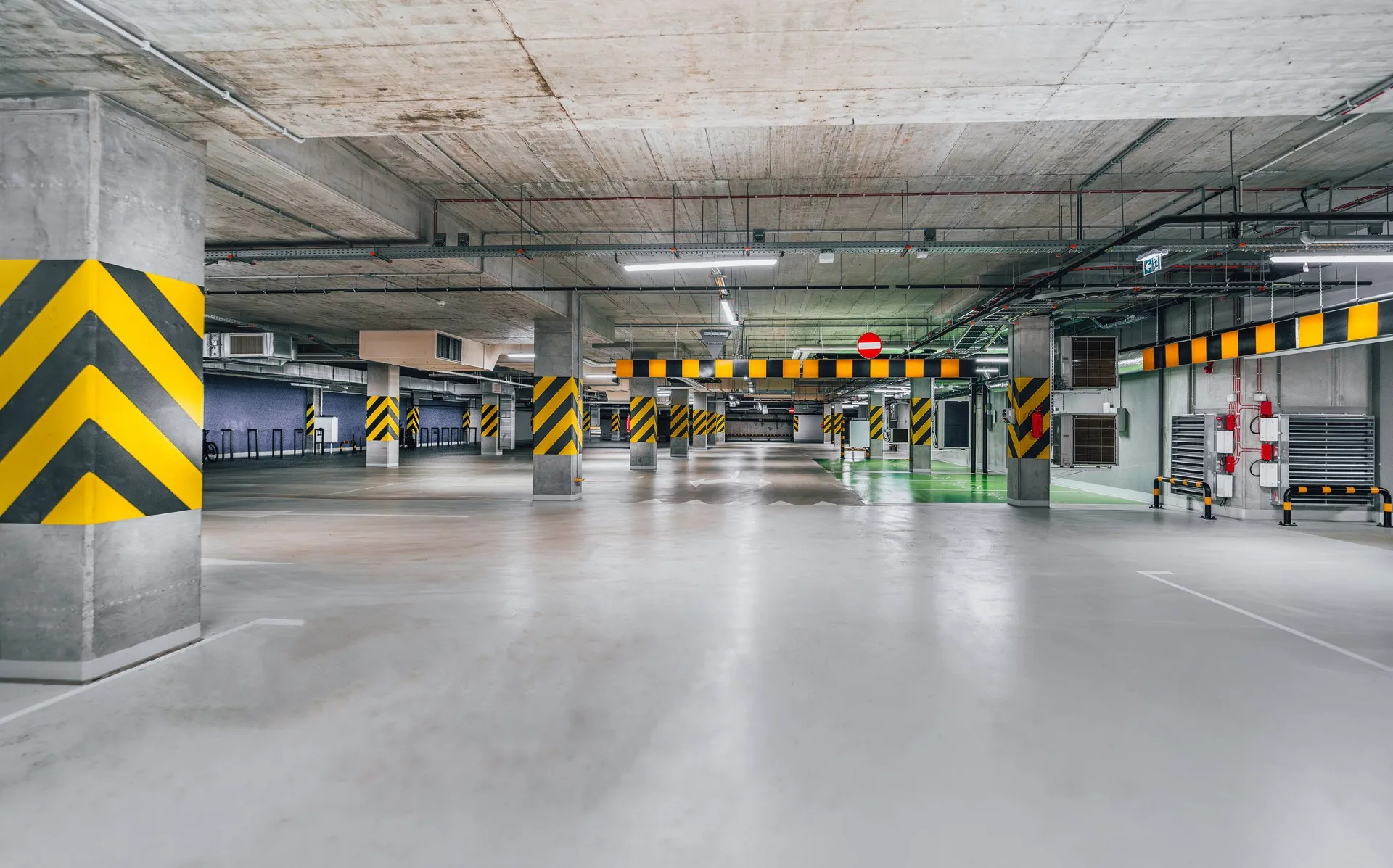
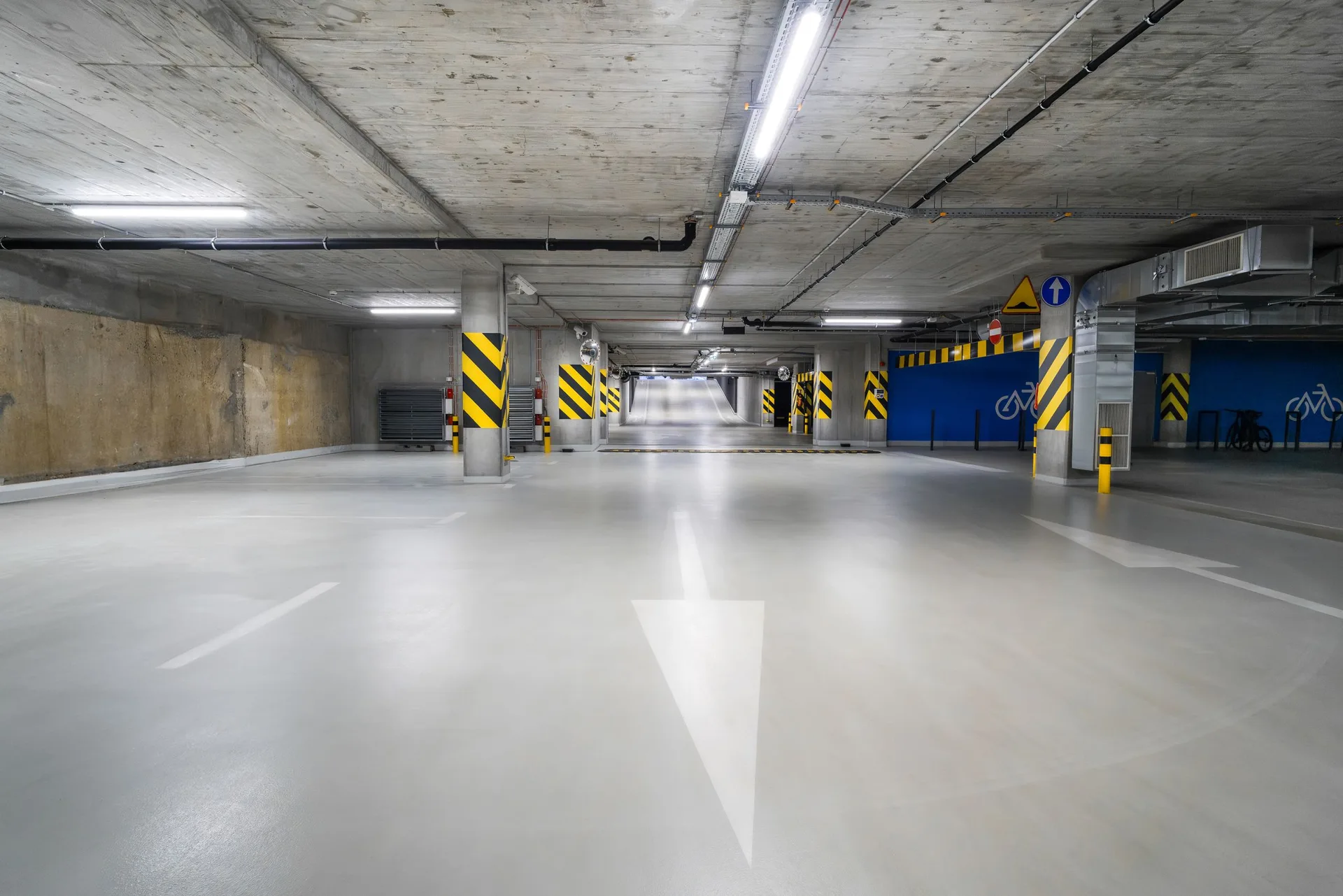
Parking garage floors that stand up to tire friction, oil and fuel drips and salt water, with an anti-slip texture on ramps. Parking bay lines, direction arrows and walkways are applied together with the coating.
Parking garage epoxy flooring is a multi-layer system, usually textured with quartz sand, that protects concrete against vehicle traffic, oil, fuel and salt water. Epoxy floor paint or a fine texture is chosen for parking bays, textured epoxy for driving lanes and a coarse-quartz anti-slip surface for ramps. The floor can be walked on after about 24 hours and opens to vehicle traffic in 3–7 days; the work can be done level by level while the garage stays in use.
Parking garage epoxy flooring is a multi-layer system, usually with an anti-slip texture, that protects concrete against vehicle traffic, drips of oil and fuel and the salt water carried in during winter. A parking garage is one of the floors in a building that receives the least attention yet is stressed the most: every day a large number of vehicles drive in, turn, brake and drip oil where they stand.
Uncoated concrete dusts under this use, and the dust is carried onto the vehicles and into the ventilation ducts. Tire friction polishes the surface over time and makes it slippery when wet, while oil stains soak into the concrete and become permanent. The really serious damage, however, is where it cannot be seen: the salt water that arrives with vehicles in winter soaks into the concrete, and when it reaches the reinforcement, corrosion begins. Water seeping through cracks drips onto the vehicles on the level below.
An epoxy coating covers the concrete with an impermeable layer. Oil and water stay on the surface and are removed by washing. Because a light-colored floor reflects light, the garage looks brighter and safer, and the parking bay lines, direction arrows and walkways can be read clearly.
There is one important point that sets a parking garage apart from other floors: a smooth, glossy surface is not wanted here most of the time. It creates a slip risk for wet tires and for pedestrians walking on a rainy day, and it causes tire squeal on turns. This is why the systems used in parking garages are predominantly those textured with quartz sand.
The parking garage of a shopping mall and that of a residential complex are not used in the same way, and vehicle service and car wash areas carry entirely different loads. We have dealt with each of them separately.
Indoor parking garages are mostly located on basement levels, and the first problem of the floor is moisture. Water coming from beneath the foundation or through the basement walls is a structural problem that has to be solved before the coating; epoxy applied to damp concrete blisters. For this reason, work in indoor parking garages starts with moisture measurement and with locating the points of seepage.
The second issue is the air: exhaust soot builds up on the ceiling and the floor, and concrete dust is drawn into the ventilation ducts. A floor that does not dust and can be washed also lightens the load on the ventilation system. Because the ceiling is low, a light-colored floor noticeably increases the effect of the lighting. The system is chosen zone by zone: epoxy paint or a finely textured coating is used in the parking bays, and a quartz-broadcast textured system on the driving lanes. So that the water carried in by vehicles on rainy days does not collect, the existing falls and the positions of the drains are examined, and the hollows where water ponds are filled before the coating.
In shopping mall parking garages vehicle circulation continues all day, and many vehicles drive in and out of the same bay in a single day. Added to this are heavy foot traffic, shopping carts and strollers. The floor therefore has to be both anti-slip for vehicles and smooth enough for small wheels; a medium-grade texture is chosen for the driving lanes and a fine texture for the walkways.
On smooth, glossy surfaces the squeal of a turning tire disturbs visitors; a textured surface noticeably reduces this noise. Wayfinding is as important as the coating itself: each level is given a separate color, and walkways, elevator lobbies and reserved parking bays are marked in different colors. Because a mall cannot be closed, the work is mostly carried out at night and level by level. For the floors of stores and common areas, you can look at our shopping and commercial spaces page.
In residential complex parking garages each vehicle generally parks in its own bay. That means the oil drip falls on the same spot for months and the tires go in and out along the same track every time. Traffic is far sparser than in a mall; this is why epoxy floor paint in the parking bays is a sufficient and budget-friendly solution for most residential complexes. Because the entrance ramp, the turning points and the main driving lane wear more, a textured system is preferred there.
The difficult side of the application is not technical but organizational: residents have to move their vehicles somewhere else for a few days. The work is divided into blocks, the schedule is announced together with the building management, and once each block is completed the next one is started. When bay numbers and visitor bays are marked on the floor, disputes over parking spaces also decrease. For garages of detached houses, you can take a look at our epoxy flooring for home garages and basements page.
Hospital parking garages operate at every hour of the day, and some routes cannot be closed even for a moment. The ambulance route, the emergency department entrance and the areas in front of departments where patients are brought in regularly are handled in the phasing plan in such a way that they always stay open. The users are different too: patients moving with wheelchairs, stretchers and walkers make their way between the garage and the building.
On pedestrian routes, therefore, the texture is chosen fine enough to prevent slipping without tiring the wheels, and no difference in level is left at thresholds. Accessible parking bays, patient drop-off bays and walkways are made to stand out in colors that contrast with the floor. In places where people wait, such as the pay station and the area in front of the elevators, it is especially important that the floor can be wiped clean easily. When working in sections close to the building ventilation, the spread of odor is taken into account; solvent-free systems and night hours make things easier in this respect. For the floors inside the building, you can look at our hospitals and healthcare facilities page.
Vehicle service areas are the quick maintenance, tire change and pre-delivery preparation sections located inside or next to a parking garage. The load here is different from that of a parking area: engine oil, brake fluid and antifreeze are spilled on the floor, jacks and lift feet place a large load on a small area, and dropped tools and wheel rims cause impact.
In these sections thin-film paint is not sufficient. Self-leveling epoxy is chosen for the reception and handover areas, where the work is dry and a clean appearance is wanted, and textured epoxy for the work bays, where oil and water are spilled frequently. The points where the lift feet sit and the edges of the channels are reinforced separately. In the tire change section small parts such as lug nuts and wheel balancing weights fall to the floor; on a seamless surface they are easily collected. Because a light-colored floor immediately shows any fluid leaking from underneath a vehicle, it also makes the technician's job easier. We have described the requirements of fully equipped workshops in detail on our automotive sector page.
In car showrooms the floor is the stage for the sale. The paintwork and lines of a vehicle look more striking when they are reflected in a glossy, one-piece floor; this is why smooth self-leveling epoxy is applied in display areas, or metallic epoxy if a bolder look is wanted.
There are two details that need to be known here. The first is tire marks: a vehicle that stands in the same place for a long time, or one that is brought inside with hot tires, can leave a mark, especially on a light-colored floor. A polyurethane topcoat applied against scratching and staining reduces this risk, and placing mats under the tires of display vehicles is also a common precaution. The second is the sun: the light coming through large glazed facades yellows epoxy over time, and a polyurethane topcoat delays the yellowing. A smooth surface is safe when dry; a washed vehicle must not be brought inside while it is wet. As for color, mid-gray shades bring the vehicle to the fore and also show dust and footprints less than a very light or a black floor does.
In car wash areas the floor hardly ever dries. Water, shampoo, polish and wheel cleaner are constantly on the surface, while the sand and mud that fall from the vehicles work like sandpaper under the brushes and the tires. Under these conditions a smooth surface is dangerous for the staff and the vehicles alike. For this reason a textured epoxy with coarse quartz and high slip resistance is applied in wash areas.
The fall is as important as the coating: the water has to run to the drain or the grated channel and must not pond anywhere. Because the edges of the channels are the line where the coating is stressed the most, they are detailed with care. Acid-based wheel cleaners must not be left standing on the surface; after use they should be rinsed away with plenty of water. Two limits have to be stated plainly. At points where washing with steam or very hot water is continuous, epoxy is not the right choice. In open-air wash yards exposed to direct sunlight, epoxy also yellows and loses its gloss; we state these situations clearly at the quotation stage.
A parking garage should be thought of not as a single floor but as the sum of zones that see different loads. The place where a vehicle stands and the place where it turns do not call for the same coating.
The transitions between zones are planned together with the change of color. The difference in color between the driving lane and the parking bay tells the driver where to stop even before the line does.
In a parking garage the choice of color is part of safety as well. Light gray driving lanes reflect the light; when the parking bays are chosen one shade darker, oil drips catch the eye less. Walkways, accessible parking bays and the hatched zones that must not be entered are marked in vivid colors that stand out clearly from the floor.
A parking garage coating consists of several layers, and each layer waits for the previous one to cure. The process moves forward as follows.
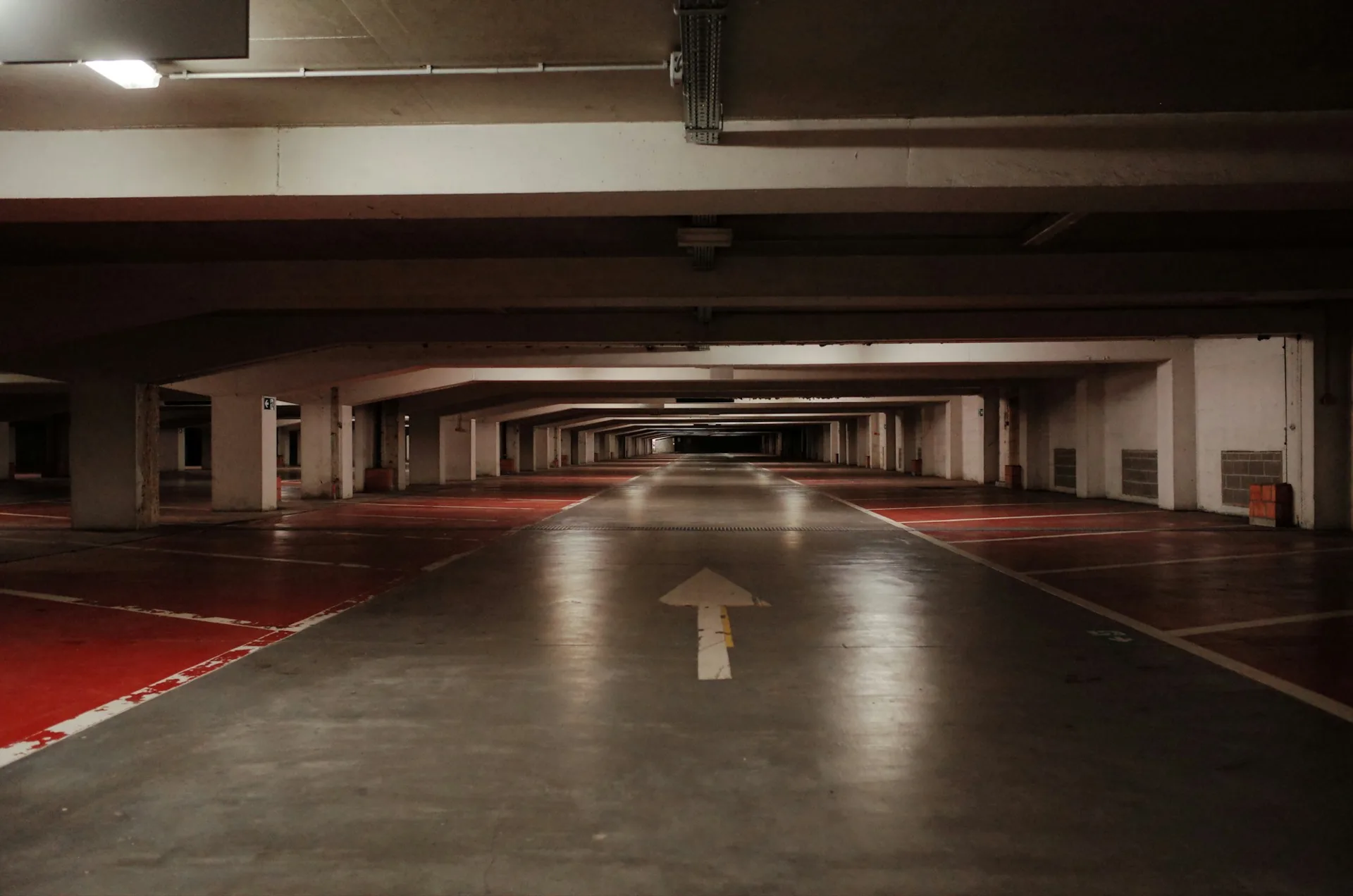
Closing a parking garage completely is rarely possible. The work is carried out level by level or by closing half of a level; where vehicles will park on those days and the temporary direction of traffic are decided in advance and announced with signs.
The most difficult phase is the ramp. In garages with a single ramp, the lower levels cannot be used once the ramp is closed; for this reason the ramp work is placed on the days when use is at its lowest, such as public holidays and weekends. On ramps that are wide enough, a two-stage application at half width can also be carried out. If the ramp is opened to traffic before the coating has fully hardened, the force exerted by the tires strips the fresh surface.
In indoor parking garages the ventilation fans are kept running throughout the application. The systems used are solvent-free; even so, the air flow is controlled so that the smell does not reach the homes or workplaces on the upper floors. Basement levels are cold in winter and curing slows down. In summer the opposite problem arises: the hot, humid air coming in from outside condenses on the cool basement floor. No application is made while there is moisture on the surface, and the working hours are chosen accordingly.
Two kinds of dirt build up on a parking garage floor: tire marks and oil drips. Neither of them penetrates the coating; they stay on the surface and are cleaned with a scrubber-dryer fitted with brushes and a suitable detergent. On textured surfaces a mop is of no use; a brush is needed. Oil left standing for a long time combines with dust and forms a sticky film; washing the parking bays at regular intervals prevents this.
The salt and sand carried in by vehicles during the winter months are a separate matter. Salt water leaves a white film when it dries, while sand abrades the surface under the tires. It is recommended that the entrance zone and the ramp be swept more often throughout the winter, and that the whole garage be washed once at the beginning of spring. The drains and grated channels must not be allowed to clog; standing water does not harm the coating, but it creates a slip risk.
Over time the first places to wear are the ramps, the turns and the areas in front of the barriers. When the texture has worn down in these zones, the surface is sanded, quartz is broadcast again and a topcoat is applied; there is no need to renew the whole garage. Parking bay lines and direction arrows are refreshed in the same way.
For a daily, weekly and yearly maintenance schedule and cleaning tips for each type of stain, see our guide Epoxy Floor Maintenance and Cleaning.
We do not quote prices on this page, because the cost of two parking garages of the same size differs markedly depending on the condition of the concrete and the distribution of zones. The items that affect a quotation are these:
We explain what to look for when comparing quotes in our article 7 Factors That Determine the Cost of Epoxy Flooring per m².
To receive a system recommendation and a price for your parking garage, you can fill in the quotation form. It speeds up the assessment if you state the total area and the number of levels, the approximate number of parking bays, the number of ramps, whether the levels are enclosed or open, whether there is any water seepage or an old coating, and for how long the garage can be closed. Adding the site layout plan, if there is one, and a few photographs is enough.
Once the information has reached us, we prepare our written quote, which includes the distribution of systems by zone, the line plan and the phasing schedule; once the quote is approved, a site survey and measurement are carried out. For other common topics you can look at the frequently asked questions page, and for examples of completed jobs at the projects page.
| Recommended system | Epoxy paint or a fine texture in parking bays; textured epoxy (3–5 mm) on driving lanes and ramps |
|---|---|
| Layers | Primer + quartz-broadcast body coat + colored topcoat |
| Surface preparation | Shot blasting; diamond grinding along the edges |
| Sections exposed to sunlight | Polyurethane topcoat against yellowing |
| Marking | Parking bay lines, bay numbers, direction arrows, walkways, accessible parking symbol |
| Open to foot traffic | Approx. 24 hours |
| Open to vehicle traffic | 3–7 days, depending on system and temperature |
A parking garage epoxy floor opens to vehicle traffic within 3–7 days, depending on the system and the ambient temperature. Foot traffic can start after about 24 hours; full strength develops in 7 days at 20 °C. Because basement levels are cold in winter, the time may be longer. Ramps and turning points are the places where the tire exerts the most force, so the waiting time there has to be observed right to the end; on a ramp opened too early, the fresh coating can be stripped.
Yes, a parking garage can be coated while it remains in use, by closing it level by level or zone by zone. The vehicles in the section being worked on are temporarily directed to another level or to an outdoor area, and once the section has cured the next one is started. The phase that demands the most attention is the ramp; in garages with a single ramp this work is placed on the days when use is lowest, or, if the width of the ramp allows, it is applied in two halves. The phasing plan is settled together with the management before work begins.
That depends on the zone and the density of traffic: in parking bays that are used sparsely, epoxy paint can be sufficient, whereas driving lanes and ramps need a thick quartz-filled system. Paint is a thin film; it prevents dusting and stops oil from soaking into the concrete, but it wears quickly under tires that are constantly turning and braking. In residential complex garages, coating the parking bays with paint and the lanes with a textured system is a frequently used solution that balances the budget.
Not when the right texture is chosen. Smooth, glossy epoxy can become slippery when it gets wet; for this reason, in parking garages the driving lanes and ramps are textured by broadcasting quartz sand. The grain size of the sand is adjusted to the zone: a coarse texture is used on ramps and turns, and a finer one on walkways. Keeping the drains clear so that water does not collect, and filling the hollows where water ponds before the coating, are also part of preventing slips.
Yes, both can be cleaned because they stay on the surface. Since epoxy is impermeable, oil does not soak into the concrete; it is removed with a scrubber-dryer fitted with brushes and a suitable detergent. Tire marks also come off with regular washing, but if they are left for months they set in and stronger cleaning is needed. On smooth, light-colored surfaces such as a display area, a polyurethane topcoat and tire mats are used against the possibility of a tire that stands in the same place for a long time leaving a mark.
For parking levels that are entirely open, under sun and rain, epoxy on its own is not the right choice. In direct sunlight epoxy yellows and loses its gloss over time; open levels also require a different solution because of temperature differences and water. In sections that receive partial sunlight, such as an entrance opening or the area under a canopy, a polyurethane topcoat can be used against yellowing. If your parking garage has an open section, this is stated clearly at the quotation stage.
We explain in plain language what epoxy flooring is, which types are available and why it is chosen for different kinds of spaces.
Every stage of an epoxy flooring installation from survey to handover: surface preparation, repairs, primer, coating layer and curing.
The two coatings look alike but behave differently. We compare epoxy and polyurethane in terms of hardness, flexibility, and UV and heat resistance.
When can you walk on an epoxy floor, and when can it take loads? Curing times by temperature and the conditions that affect the process.
An epoxy floor needs little maintenance, but it should not be neglected. Everything you need to know, from daily cleaning and stain removal to the…
Our priority is
Tell us about your project, and together we will pin down the right epoxy system for your floor, the application time and our quote.
Get a Quote5-year workmanship and 10-year product warranty. We respond to all requests within 24 hours. We work in all 81 provinces.