
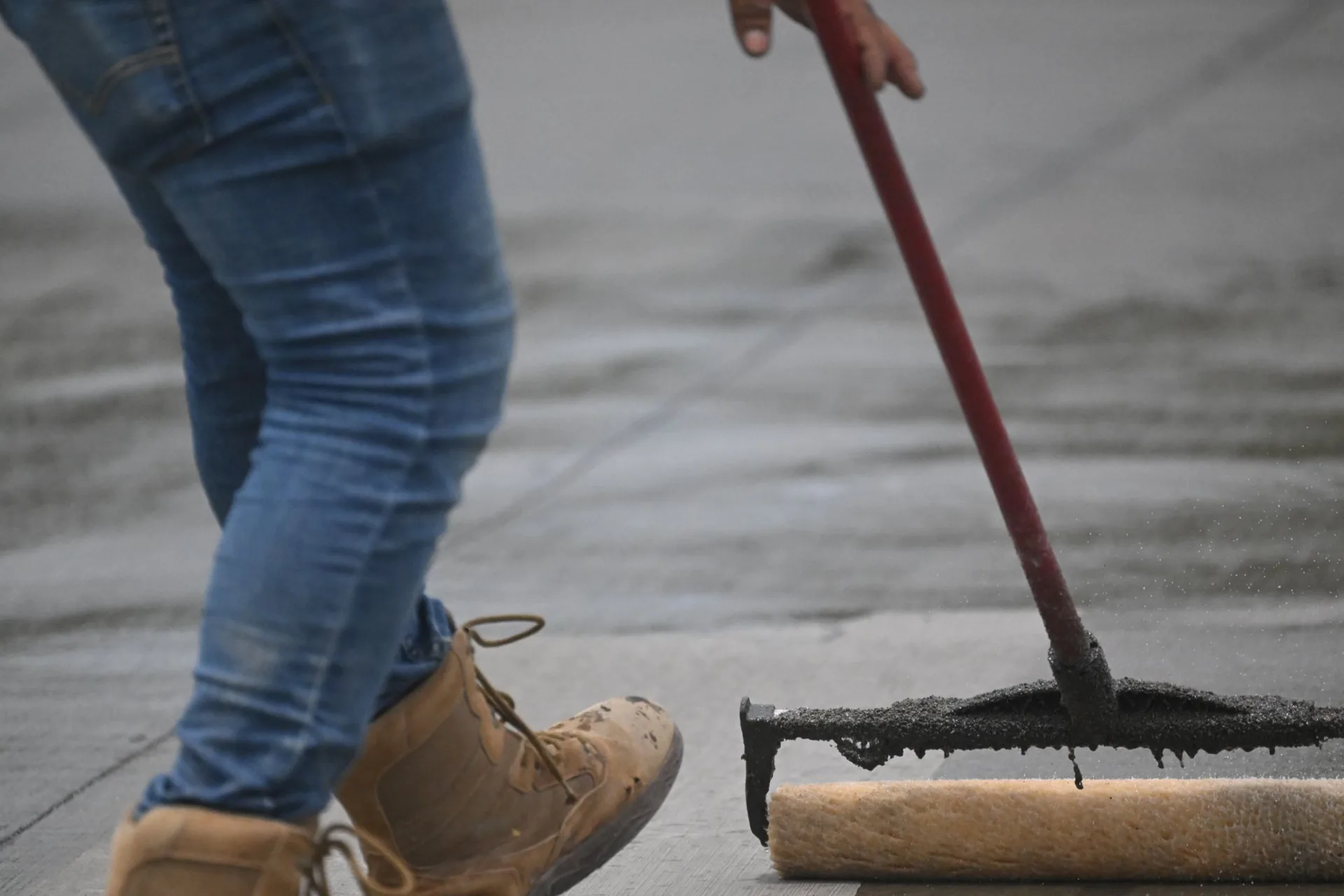
How Long Does Epoxy Flooring Take to Cure? Curing Times
When can you walk on an epoxy floor, and when can it take loads? Curing times by temperature and the conditions that affect the process.
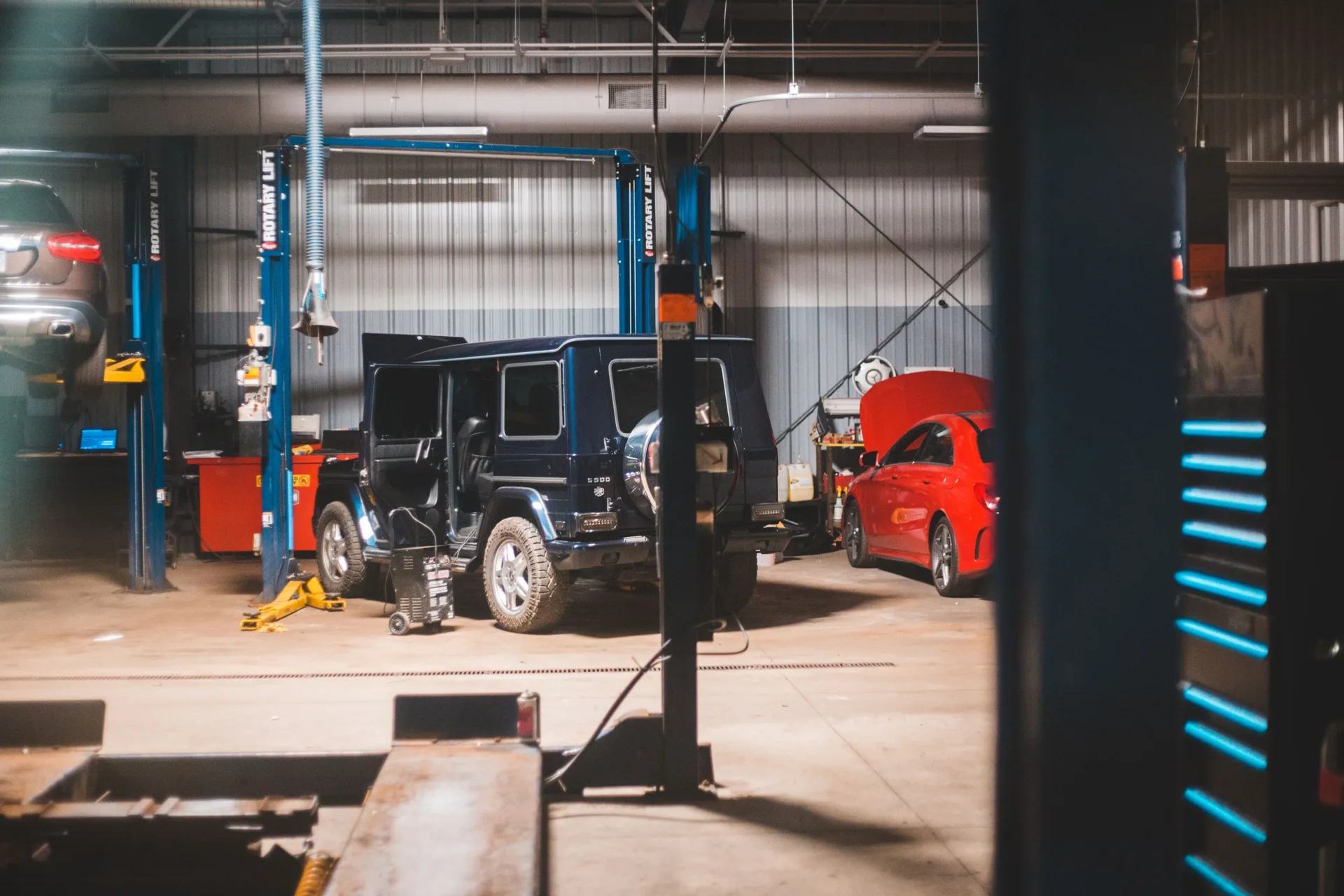
Epoxy flooring for auto repair shops, tire shops, body and paint shops, vehicle inspection stations and spare parts warehouses that resists oil, fuel, tire marks and lift loads.
Auto repair shop epoxy flooring stops engine oil, fuel and antifreeze from soaking into the concrete, withstands jack and jack-stand loads and is easy to clean. Lift bays and repair zones get 3–5 mm quartz-filled textured (anti-slip) epoxy, vehicle reception and handover areas get 2–3 mm self-leveling epoxy, and the parts store and tire hotel get epoxy paint. On oil-soaked concrete, surface preparation determines the result. The floor can be walked on after about 24 hours and opens to vehicle traffic in 3–7 days.
Auto repair shop epoxy flooring protects the concrete against the everyday realities of the workshop: dripping engine oil, spilled fuel and antifreeze, hot tires, jack and lift loads, wrenches dropped on the floor. Uncoated concrete is porous; it soaks up oil like a sponge and never lets it go again. Over time it darkens, turns slippery, gives off dust and, in the customer's eyes, makes the business look neglected.
In shops with ceramic tile floors, the problem shows up in a different form. Tiles crack under jacks and jack stands, the joints fill with oil, and broken edges catch the wheels of the mechanic's creeper and the jack. A dropped rim or brake drum dislodges not just one tile but the ones around it as well.
An epoxy coating covers the floor with a seamless, liquid-tight layer. Spilled oil stays on the surface and is wiped away. A light-colored floor brightens the workshop; the technician working under the vehicle sees better, and a bolt or snap ring that falls on the floor is easy to find. When lift bays, walkways and vehicle waiting areas are separated by lines, the layout of the workshop falls into place by itself.
In many shops today, customers watch their vehicle from behind a glass partition. A clean, orderly floor has a direct effect on the confidence they have in the work being done. This result, however, depends on the right system being applied to correctly prepared concrete; the most common failure in the automotive sector is thin paint applied to oily concrete without enough preparation.
Each type of automotive business wears its floor in a different way. The impact in a tire shop and the solvent in a paint shop are not met with the same system. Below you will find the areas we work in most often in the sector and the details that stand out in each of them.
In dealer and independent repair shops, the floor is divided into several zones: vehicle reception, lift bays, mechanical repair, the parts counter and the handover area. In the lift bays, oil, brake fluid and coolant drip onto the floor, and jack stands and transmission jacks put a large load onto a small area. In these zones a quartz-filled system is applied at a thickness of 3–5 mm; the light texture keeps the technician's feet from slipping on an oily floor without making cleaning harder.
The vehicle reception and handover areas are the places the customer sees; here, smooth, glossy self-leveling epoxy is preferred. If there is a sales showroom under the same roof, metallic epoxy or a single-color glossy floor makes the vehicle stand out; for these areas, see our retail store and showroom epoxy flooring page. In repair shops we mark the boundary of every lift bay, the walkway and the vehicle maneuvering lane on the floor with lines.
At quick-service points and at fleet and heavy-vehicle maintenance centers, the work is periodic maintenance rather than repair: oil and filter changes, brakes, batteries, air conditioning. Vehicle turnover is high; vehicles enter and leave along the same lane all day long. If oil changes are done from a pit, the pit edges and steps are the riskiest points on the floor. These are coated with a coarse-textured anti-slip system, and the edges are highlighted in a warning color.
The waste oil collection point, the corner where drums and cans stand and the battery charging section are where spills happen most often; in these zones the coating is turned up at the base of the wall so that liquid cannot seep into the wall or the adjoining room. At centers that maintain trucks and buses, axle loads and hydraulic jacks are far heavier than with passenger cars; the soundness of the concrete itself is checked as well as the coating thickness. If there is a vehicle wash section, a fall toward the drains and high slip resistance are required.
In the body shop section, the floor lies beneath hammering, grinding and welding work. Weld spatter and grinding sparks can leave pinpoint burn marks on an epoxy surface; at points where a lot of welding is done, we recommend protecting the floor with sheet metal or a welding blanket. Frame straightening benches are anchored to the floor and transfer large forces to the concrete during pulling; these anchors work against the concrete, not the coating.
In the paint preparation section there is body filler dust, the slurry from wet sanding and paint dust. A smooth self-leveling surface allows dried paint drips to be scraped off. Color choice is a technical matter here: a neutral light gray floor is less misleading to the painter judging a color shade than a dark or colored floor. Thinners and solvents can dull the surface if they are spilled and left to stand; they should be wiped up immediately. In spaces where flammable vapors are present, such as the paint mixing room and the solvent store, anti-static epoxy is applied if the facility's explosion protection assessment calls for a conductive floor.
In a tire shop, what wears the floor is impact rather than liquid. A removed rim is set down on the floor, lug wrenches and impact guns are dropped, and a floor jack carries the weight of the vehicle on a narrow wheel. Wheel weights and stones that come out of the tires are crushed under the wheels and scratch the surface. That is why thin-film paint does not last long in tire shops; a thick, quartz-filled, impact-resistant system is needed.
The second issue is tire marks. The tire itself leaves black scuff marks on the floor, and stacked tires can also mark a light-colored surface when they stay in the same place for a long time. For this reason a mid-tone gray is recommended in the working zone rather than very light colors. The tire hotel section, where winter and summer tires are stored, sees light traffic; here epoxy paint is sufficient, and the rack rows can be numbered on the floor. The areas around the anchors of tire changers and wheel balancers are detailed one by one.
At inspection stations, vehicles move along the same lane without a break; they drive onto the brake tester rollers, pass over the pit and head for the exit. Wear is concentrated in the two narrow strips the wheels travel over every day. On entering and leaving the brake test, the tire scrubs hard against the floor; these are the points where the coating is under the most strain. In winter, vehicles bring in mud, snowmelt and road salt.
Under these conditions a thick, anti-slip, quartz-broadcast system is applied along the lane. The junction between the frames of the test equipment set into the floor and the coating is detailed with care; the levels around the equipment are not altered. The edges of the inspection pit are marked out with a warning color and an anti-slip texture. Lane lines, waiting points, direction arrows and pedestrian routes are essential to the running of the station and are applied together with the coating. On heavy-vehicle lanes the loads increase markedly, and the condition of the concrete is assessed separately. Because stations usually cannot be closed completely, the work is carried out lane by lane.
In spare parts warehouses, thousands of small items are stored on shelves in boxes and bags. Dusting concrete dirties the packaging and makes labels and barcodes unreadable; handing over parts such as brake pads or filters covered in dust leaves a poor impression on the customer. Traffic between the shelves is mostly on foot and by hand cart; in these sections, epoxy floor paint stops dusting economically.
The main aisles where pallet trucks or forklifts operate, and the areas in front of goods receiving and dispatch, carry more load; here self-leveling epoxy is preferred. The shelving section where products containing liquids are stored, such as engine oil, antifreeze and batteries, can be set up as a separate zone in which the coating is turned up at the base of the wall against spills. When aisle numbers and shelf addresses are written on the floor, parts picking speeds up. For large distribution warehouses, the principles on our warehouse epoxy flooring page apply.
To choose the right system in the automotive sector, you first need to know, one by one, what acts on the floor.
One question we are often asked is whether the whole shop can be coated with paint. In zones that vehicles enter and where lifts are used, paint wears through in a short time; we do not recommend paint for these zones. If the budget is limited, the right way is to solve the lift bays with a thick system and the stores and back rooms with paint.
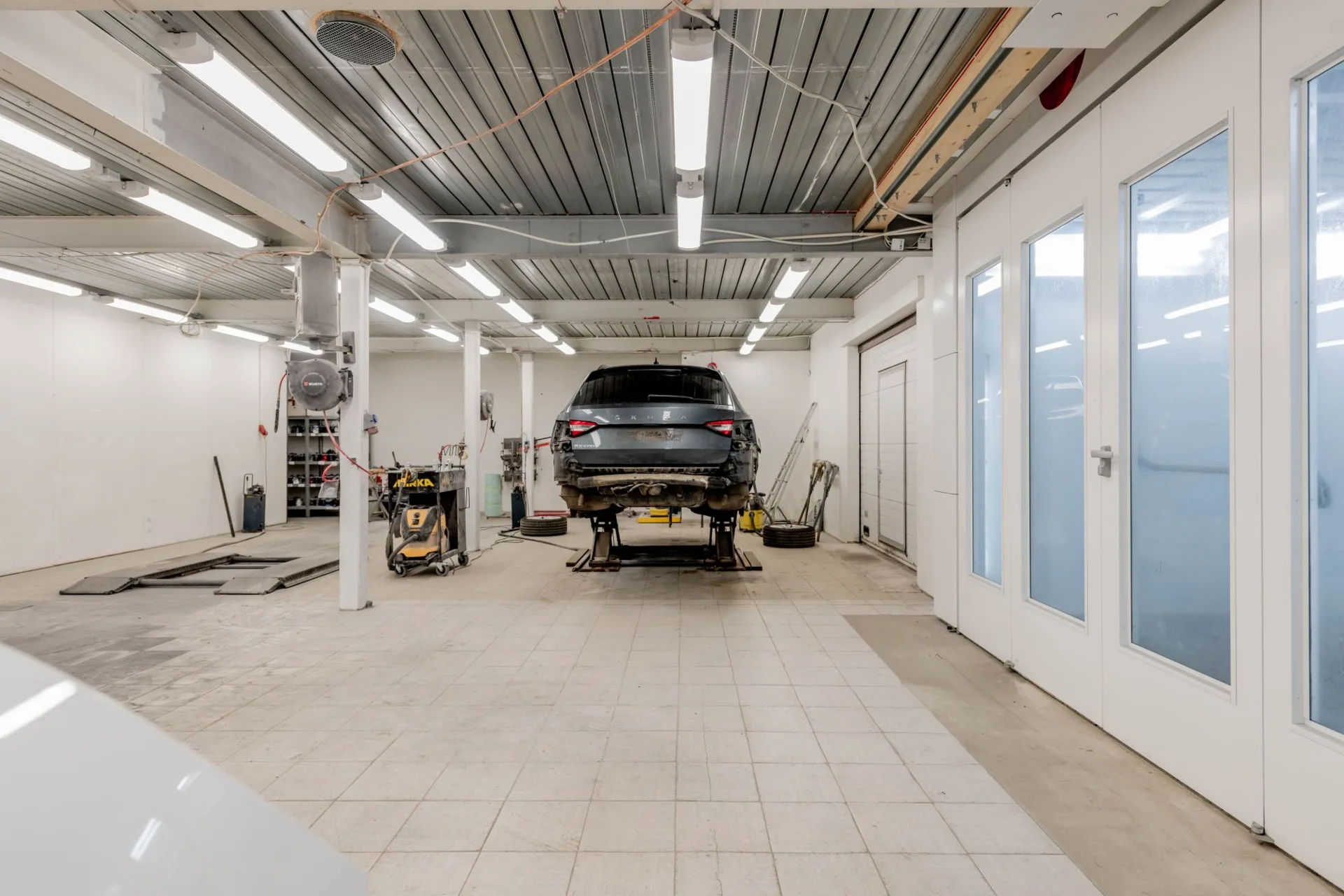
A repair shop's income is generated by its lifts; closing all of them at once is not possible for most businesses. That is why the work is usually split into phases.
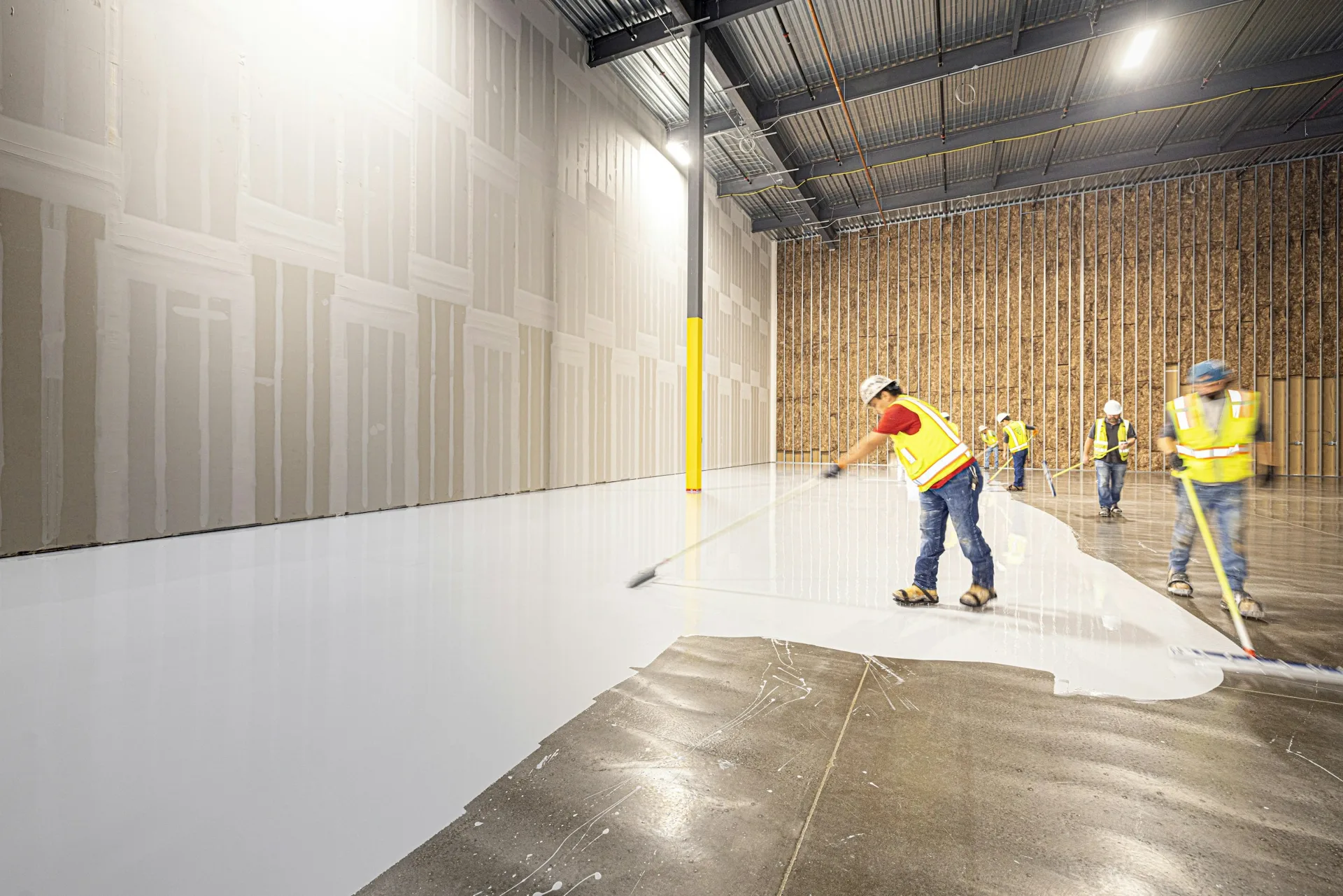
The most common timing mistake is bringing vehicles onto the floor too early. A floor that can be walked on after twenty-four hours is not yet ready for the force a vehicle tire applies as it turns. When the steering wheel is turned with the vehicle stationary, the tire twists the not-yet-hardened coating and leaves a mark. In cold weather curing takes longer; in workshops whose doors stand open all the time in winter, this is factored into the schedule separately.
Solvent-free systems are low in odor, but while the application is under way no welding or grinding should be done in that zone and no vehicle should be started. Dust and exhaust soot stick to the wet coating.
How long an epoxy floor lasts in a repair shop depends on how long spills stay on the floor. The daily routine is simple:
Once a year, the areas in front of the lifts, the door entrance and the pit edges should be inspected. A worn topcoat is renewed by sanding the surface and reapplying it. Deep damage is repaired on the spot; there is no need to strip the entire coating. The lines can also be refreshed as they wear.
For a daily, weekly and yearly maintenance schedule and cleaning tips for each type of stain, see our guide Epoxy Floor Maintenance and Cleaning.
In a newly built repair shop, the most economical time is after the concrete has finished curing and before the lifts are installed. The floor has not yet seen any oil, the area is empty and the coating runs uninterrupted under the lift plates.
We explain what to look for when comparing quotes in our article 7 Factors That Determine the Cost of Epoxy Flooring per m².
We set out the right system and a realistic work program in a written quote prepared from the information and photos you send us; once the quote is approved, we survey and measure the workshop on site. As a first step, you can fill in the quote request form. Writing down the following information makes our work easier:
For vehicle parking areas, take a look at our parking garage epoxy flooring page, and for all our systems, the services page. For questions, you can reach us through the contact page.
| Lift bays and repair zones | Textured (anti-slip) epoxy, 3–5 mm |
|---|---|
| Reception and handover area | Self-leveling epoxy, 2–3 mm |
| Parts store and tire hotel | Epoxy floor paint, 0.3–0.5 mm |
| Surface preparation | Degreasing, shot blasting or diamond grinding |
| Open to foot traffic | Approx. 24 hours |
| Open to vehicle traffic | 3–7 days |
| Full cure | 7 days (20 °C) |
The floor can be walked on after about 24 hours, while vehicles are brought in after 3–7 days, depending on the system and the ambient temperature. Full cure takes 7 days at 20 °C; in cold weather this takes longer. Bringing vehicles in early is the most common mistake, because a tire turning on the spot leaves a permanent mark on a surface that has not yet hardened. For businesses that do not want to close the shop completely, the workshop is divided into zones and the lifts are taken out of service in turn.
It can, but the preparation is far more extensive than on new concrete. The surface is first washed with a degreaser, and then the oily top layer is removed by shot blasting or diamond grinding. At points where the oil has penetrated deep, the concrete is opened up more deeply and, if necessary, that section is renewed. A primer suited to this condition is then applied and adhesion is tested on a small area. On oily floors that are only washed with detergent and then coated, the coating lifts in a short time.
On thin, poorly bonded paints, yes; a hot tire can soften the film and lift it off the floor. With thick epoxy systems applied to well-prepared concrete, no lifting occurs. The plasticizers in tires, however, can leave a yellowish shadow under vehicles that stand at the same spot for a long time, especially on very light colors. Choosing a mid-tone gray in the zones where vehicles wait and using a topcoat that resists tire marking reduces this effect to a large extent.
Yes, it can; in that case the areas around the lift base plates and posts are detailed one by one. Even so, we recommend dismantling two-post lifts where possible, because when the coating runs uninterrupted under the plate, no junction is left at its edge for oil to seep through. The lift is anchored into the concrete again once the coating has hardened sufficiently. With scissor lifts and in-ground lifts, the pit edges are made good together with the coating.
Brief contact does no lasting damage, but if they are left for a long time they can leave a mark. Brake fluid behaves like a strong solvent; if it stays on the surface for hours it can dull or soften the coating. Battery acid is a dilute acid and epoxy resists it, yet spills should still not be left to stand. The rule is simple: when these liquids drip, they are picked up with an absorbent cloth and the spot is wiped. In places where spills are frequent, such as the battery charging section, the topcoat is selected accordingly.
In zones that vehicles enter and where lifts, jacks or jack stands are used, paint is not enough; a film 0.3–0.5 mm thick is punctured under point loads and wears through quickly under tire abrasion. These zones need a 3–5 mm quartz-filled system. Paint is the right and economical choice for spaces that vehicles do not enter, such as spare parts shelving, the tire hotel, the archive and the compressor room. In most repair shops the two systems are used together.
When can you walk on an epoxy floor, and when can it take loads? Curing times by temperature and the conditions that affect the process.
We explain in plain language what epoxy flooring is, which types are available and why it is chosen for different kinds of spaces.
Why do epoxy flooring prices vary so much from one project to the next? We explain the items that make up the price so that you can compare quotes…
Every stage of an epoxy flooring installation from survey to handover: surface preparation, repairs, primer, coating layer and curing.
The two coatings look alike but behave differently. We compare epoxy and polyurethane in terms of hardness, flexibility, and UV and heat resistance.
An epoxy floor needs little maintenance, but it should not be neglected. Everything you need to know, from daily cleaning and stain removal to the…
Our priority is
Tell us about your project, and together we will pin down the right epoxy system for your floor, the application time and our quote.
Get a Quote5-year workmanship and 10-year product warranty. We respond to all requests within 24 hours. We work in all 81 provinces.