
What Is Epoxy Flooring? Types, Benefits and Applications
We explain in plain language what epoxy flooring is, which types are available and why it is chosen for different kinds of spaces.
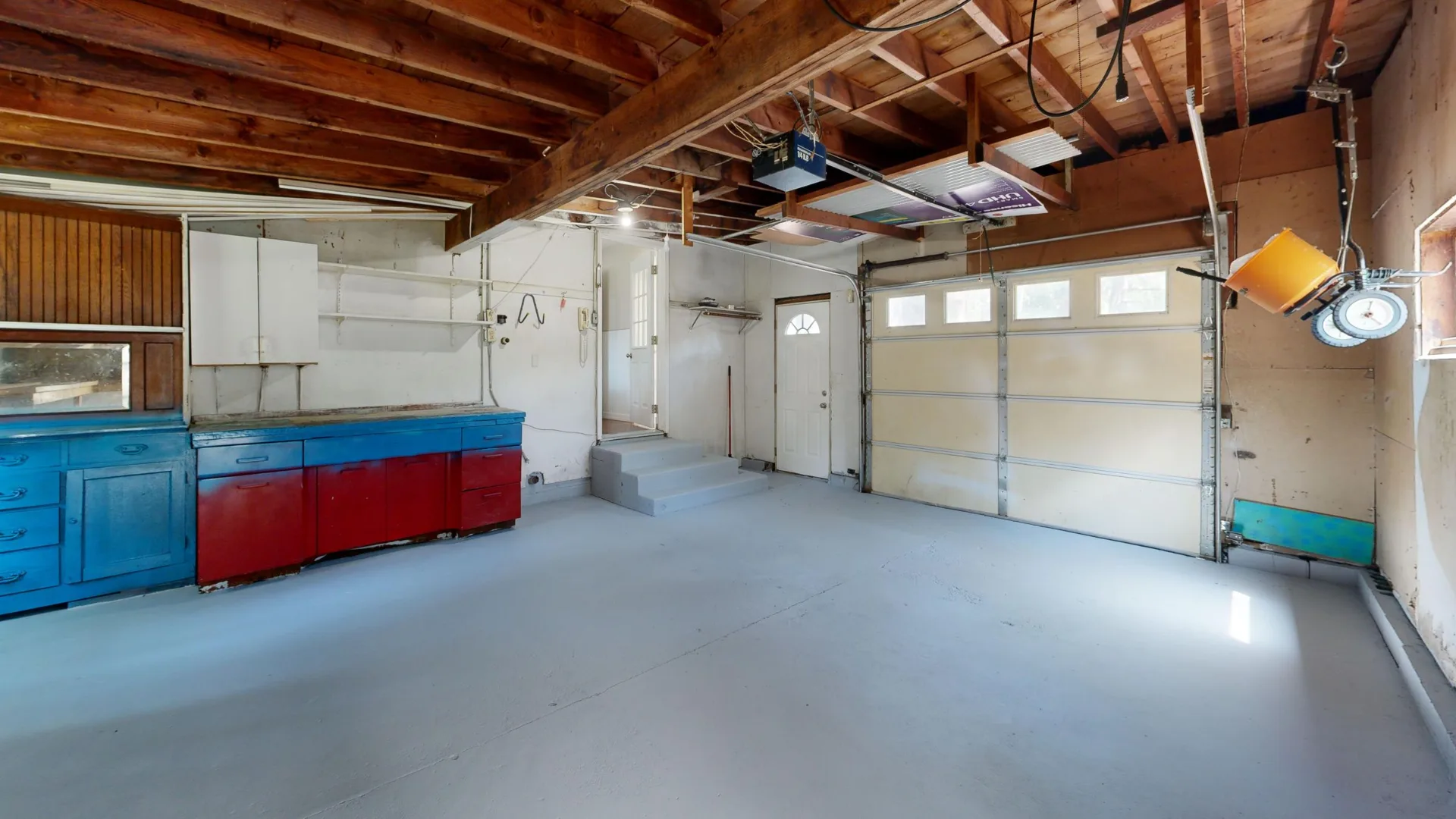
Dust-free, oil-resistant and easy-to-clean epoxy floors for detached house and villa garages, residential car parks, building basements, storage rooms, boiler rooms, shelters, shared stairs and hobby workshops.
Home garage and basement epoxy flooring gives detached house and villa garages, car parks of residential complexes and buildings, basements, storage rooms, boiler rooms and shelters a floor that does not dust, does not absorb oil and is easy to wash. Epoxy floor paint is chosen for little-used areas, 2–3 mm self-leveling or flake epoxy for garages that a car enters every day, and a textured anti-slip finish for ramps and wet entrances. In basements, the moisture of the concrete is measured first. Because epoxy yellows in direct sun, sunlit sections are protected with a UV-resistant aliphatic polyurethane topcoat; on fully open areas epoxy alone is not recommended.
Home garage and basement epoxy flooring gives the service areas of residential buildings a floor that does not dust, does not absorb oil or stains and is easy to wash. Detached house and villa garages, residential car parks, building basements, storage rooms, cellars, boiler rooms, shelters and shared stairs are the places where the floor is under the most strain yet receives the least attention. Epoxy turns these surfaces into a seamless, wipeable and bright floor.
Uncoated garage concrete dusts over time. The dust settles on the car, is carried on shoes into the house and onto the stairs, and covers whatever sits on the shelves. Dripping engine oil soaks into the pores of the concrete and never comes out again. In basements and car parks, bare concrete gives off dust every time it is swept and looks damp and neglected; in winter, the salty mud brought in by cars also wears the concrete surface.
It is important to set expectations correctly from the start. A thin floor paint is enough for a little-used storage room, while a garage that a car enters every day needs a thicker system. Epoxy is a hard floor: it does not absorb impact, it yellows in direct sun, and it lifts off poorly prepared or damp concrete. On this page we explain clearly which system is right for which area and where epoxy alone is not enough.
On the residential side, the areas we work on are detached house and villa garages, car parks of residential complexes and residential buildings, building basements, storage rooms and cellars, boiler rooms, shelters, shared building stairs and basement corridors, and hobby workshops. We do not carry out work inside apartments (living rooms, bedrooms, kitchens, bathrooms). If you are looking for a decorative floor for a business such as a shop, showroom or office, see our epoxy flooring for shopping malls and retail stores page.
In home garages, the floor is stressed by car tires, dripping engine oil, fuel and brake fluid, and the muddy, salty water carried in by the car in winter. After a long drive, hot tires can soften and lift thin paints that have not bonded well to the concrete; this is the most common problem on garage floors, and the solution is proper surface preparation. In little-used garages where the only aim is to stop dusting, epoxy floor paint is an economical option. In garages that a car enters and leaves every day, 2–3 mm self-leveling epoxy withstands tire wear for longer.
In villa garages where appearance also matters, flake epoxy is a good option: the flakes broadcast onto a colored epoxy coat are sealed with a clear topcoat, and the speckled surface hides dust, tire marks and small defects in the concrete. At the threshold where wet tires come in and on a sloping entrance, a textured finish reduces slipping. We usually finish the coating at the line where the garage door closes; the ramp outside the door is assessed separately because it is exposed to sun and rain. A light-colored floor brightens the garage.
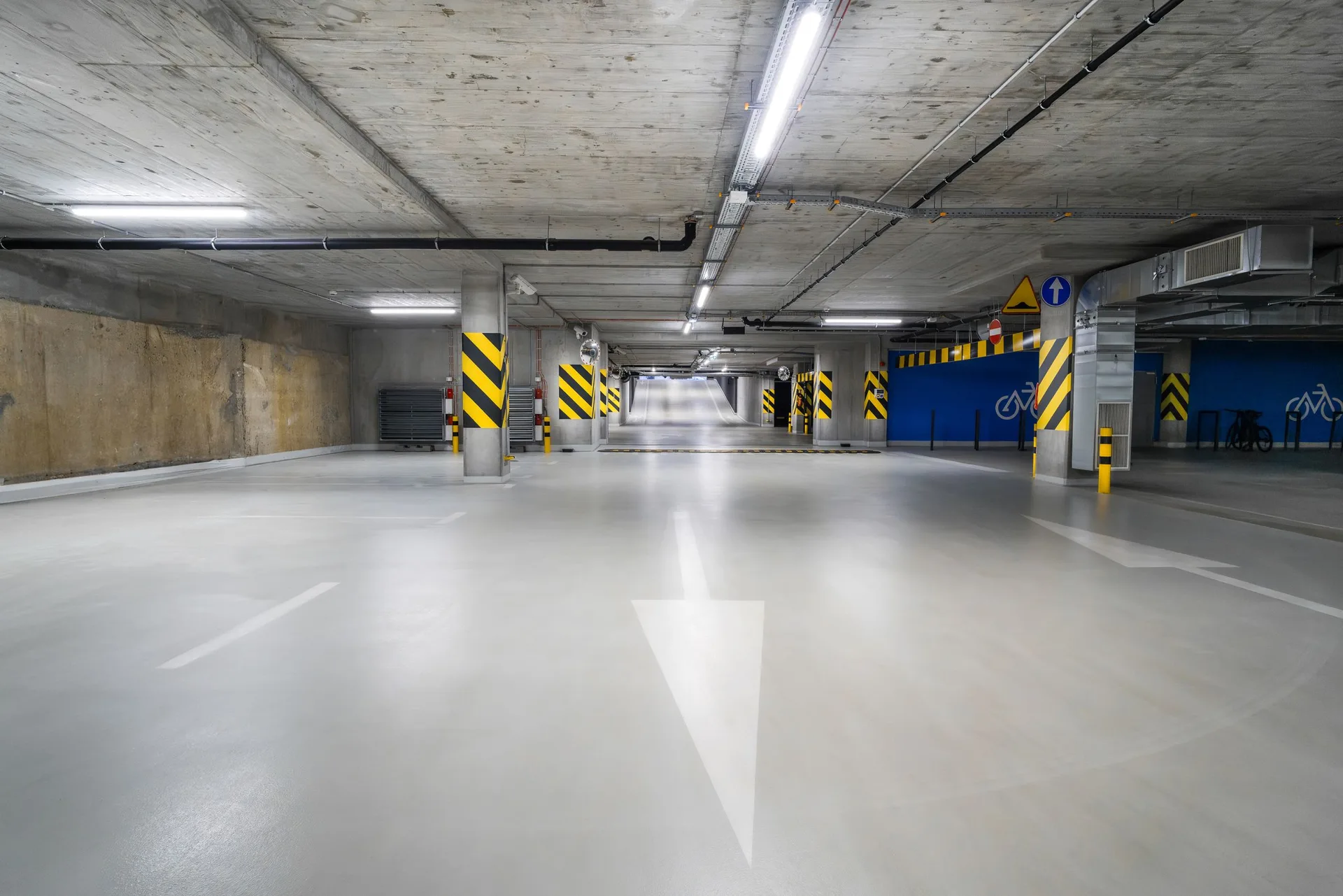
The enclosed car parks of residential complexes and residential buildings are shared areas that many cars enter and leave every day, and they are often located in the basement. The floor is stressed by tire friction, parking maneuvers, oil drips and salty water carried in during winter. Here, 2–3 mm self-leveling or textured epoxy is a long-lasting solution; in small car parks with light traffic, epoxy floor paint may also be enough. Parking bay lines, numbers and direction arrows are applied in the final stage.
The ramp is the most heavily stressed and most slippery part of a car park; a textured anti-slip finish is chosen for the slope that cars descend with wet tires. If water is seeping from the ceiling or walls, waterproofing must be solved first; epoxy is not a waterproofing material. For large enclosed car parks and ramp details, take a look at our parking garage epoxy flooring page.
In basements, the deciding issue is moisture. Slabs on ground can receive water vapor from below; an impermeable coating traps this vapor underneath and blisters over time. That is why we measure the moisture of the concrete before choosing a system for a basement. If it is below 4%, the standard system is applied; if it is higher, a primer with moisture-barrier properties is used or the floor is left to dry. If water seeps through the walls or occasionally collects on the floor, waterproofing must be solved first.
In basements used as storage rooms and cellars, epoxy floor paint stops dusting and makes the floor wipeable; in storage rooms with heavy shelf and box traffic, a thicker system may be preferred. Solvent-free products are used in these poorly ventilated spaces. Light colors noticeably brighten a basement that gets little light.
Boiler rooms are the technical spaces of a building: on the floor you find water leaking from the installation, dirty water spilled during maintenance, fuel drips in older buildings, and dust. Epoxy makes the floor wipeable and makes it easy to notice where a leak is coming from. If there is a floor drain, the coating is finished without disturbing the slope and without covering the drain opening. Epoxy does not withstand continuous hot water and steam; if there is a point where hot water is regularly discharged, a heat-resistant system such as polyurethane concrete is considered for that section.
In most buildings, shelters are poorly ventilated basement spaces that stay closed for long periods and are used for storage. Moisture is measured first; since the aim is to stop dusting and make the floor cleanable, epoxy floor paint is usually enough. During application and curing the doors are kept open, and a fan is used if necessary.
Shared building stairs and basement corridors are used every day by all residents. On shared stairs our priority is slip resistance: a fine textured finish or a matte finish is chosen for treads and landings. Mosaic, marble or previously painted steps can be roughened and coated if they are sound; broken stair nosings are repaired first. A contrasting strip on the stair nosing makes each step easier to see.
Basement corridors are usually narrow, dimly lit passageways leading to storage rooms, the car park or the boiler room. A light-colored epoxy floor brightens the corridor; applied together with a coved skirting, it reduces dirt build-up along the bottom of the walls. For sports and social facilities within a residential complex, see our gym and sports facility epoxy flooring page.
In hobby workshops set up in the garage, garden or basement of a detached house, the floor must withstand spilled paint, glue, oil and sawdust and be easy to clean. For woodworking, metalwork, and car and bicycle maintenance, self-leveling epoxy provides a flat, wipeable surface; wheeled workbenches and tool carts move easily. In pottery workshops where water is used, a textured finish reduces slipping.
In a workshop that no car enters and where appearance matters, metallic and decorative epoxy can be chosen; however, the metallic system is designed for foot and light wheeled traffic, and we do not recommend it for garages that cars enter. Because epoxy does not absorb impact, a rubber mat should be laid in front of workbenches where heavy parts fall. Solvents such as thinner should be wiped up without delay, and hot welding spatter or a soldering iron should not be placed directly on the floor.
The choice depends on how much stress the area is under, whether it gets wet and how important appearance is; it is normal to use different systems for the car park and the storage rooms in the same building.
| System | Thickness | Suitable areas | Notes |
|---|---|---|---|
| Epoxy floor paint | 0.3–0.5 mm | Little-used garages, storage rooms, cellars, boiler rooms, shelters | Economical; does not hide the concrete texture and peels under hot tires on an unprepared surface |
| Self-leveling epoxy | 2–3 mm | Garages with daily car traffic, residential car parks, hobby workshops | Flat, thick and long-lasting; can become slippery when wet |
| Flake epoxy | Varies by product | Villa garages, hobby workshops | Its speckled pattern hides dust and tire marks; slightly textured surface |
| Textured (anti-slip) epoxy | 3–5 mm | Ramps, garage entrances, shared stairs, areas that get wet | Provides grip when wet; a coarse texture makes cleaning harder |
| Aliphatic polyurethane topcoat | Thin protective coat | Sunlit sections | Delays yellowing; not a floor system on its own |
We need to be clear on this. Epoxy yellows, dulls and gradually chalks in direct sunlight; in other words, its surface turns into a layer that leaves powder on your hand when touched. In an open-air area, rain, frost and the movement caused by the temperature difference between night and day are added to this. That is why epoxy alone is not the right choice for areas such as the open ramp in front of the garage door or the uncovered section of a residential car park; we state this clearly at the quotation stage.
Epoxy can be used in enclosed and semi-enclosed sections: garages whose door stays open all day and lets in sunlight, workshops with glazed fronts, and car park sections that are covered but open at the sides. In these sections a UV-resistant aliphatic polyurethane topcoat is applied over the epoxy; the topcoat delays yellowing and protects the surface against scratching. A textured finish is chosen where rain can reach. For fully open areas, we recommend either limiting the coating to the enclosed section or jointly assessing a separate system suitable for outdoor use; we set the boundary during the site survey by looking at how far the sun and rain reach.
What most affects the result is what lies beneath the epoxy; a coating is only as sound as the substrate it sits on.
Because epoxy is only a few millimeters thick, it does not noticeably raise the floor level; garage and corridor doors can usually stay as they are. Moving cracks and expansion joints are not bridged with epoxy but protected with a flexible filler.
In garages and car parks, mid-gray is the most practical color: it shows tire marks and dust less than very light or very dark colors. In basements, storage rooms and corridors, light shades brighten spaces that get little light. Keep in mind that dark and very glossy surfaces show dust, footprints and fine scratches more clearly.
The level of gloss matters as much as the color. A glossy surface reflects light and makes the garage look bright but becomes slippery when wet; a matte or finely textured surface hides everyday marks and improves grip. In residential car parks, parking bay lines, numbers, walkways and direction arrows are applied with epoxy paint compatible with the coating. On shared stairs, marking the stair nosing in a contrasting color and showing the anti-slip texture on the ramp with a color difference improves safety.
The most frequently asked question is whether the house or building can be used during the work. If only the garage, basement or storage room is being coated, the house and building remain in use; the coated section is not walked on for about a day, and the car is kept outside for seven days, because hot tires entering too early can leave marks.
In the car parks of residential complexes and buildings, cars have to be moved elsewhere, so we plan the work section by section together with the building management; once each section has cured and been opened to cars, we move on to the next. The joint line between sections is placed on natural boundaries such as a column line or a parking bay line. If the shared staircase is the building's only route, the work is done in two stages, half the width at a time; in this case the joint line between the two halves may be slightly visible.
In enclosed basements and car parks, solvent-free or water-based products are preferred; the odor is mild and disperses quickly with ventilation. The application temperature must be between 10 and 30 °C, and the floor temperature must stay at least 3 °C above the dew point. In unheated garages and basements, curing takes noticeably longer in winter: when the temperature drops by 10 °C, the curing time roughly doubles. Since dust, leaves and insects landing on the wet coating stay on the surface, doors are opened in a controlled way during curing and pets are kept away from the area.
Maintaining a garage or basement epoxy floor is simple. A soft broom or a microfiber mop is enough for regular cleaning, and lukewarm water with a neutral detergent for washing. Sand grains carried in on shoes and tires act like sandpaper; a mat placed at the garage and building entrance keeps the surface glossy for a long time.
Oil, fuel and brake fluid drips should be wiped up without delay, and the salty mud brought in by cars in winter should be washed off from time to time. Tire marks largely come off with a neutral detergent and a soft brush; if a scrubber is used in a residential car park, soft brushes and pads should be chosen. Steel wool, abrasive scouring powders and undiluted bleach dull the surface. A floor that loses its gloss over the years is renewed by light sanding and a new topcoat; the coating does not need to be removed.
For a daily, weekly and yearly maintenance schedule and cleaning methods by type of stain, see our guide on epoxy floor maintenance and cleaning.
The main cost items in garage, basement and common-area work are:
We explain in detail the factors that raise or lower the price per m² in our article 7 factors that determine the cost of epoxy flooring per m².
So that we can recommend the right system, simply state in the quote request form the area to be coated (such as a villa garage, residential car park, basement, storage room, boiler room or shared staircase), the approximate floor area, what the existing floor is, the vehicle traffic, whether it gets sun, and any moisture or water seepage problem. If you add a few photos of the floor, we can prepare the quote more precisely.
With this information we send you our written quote; once the quote is approved, we come for an on-site survey and, by measuring the moisture and soundness of the floor, finalize the application plan together with you. You can find examples of completed work on the projects page and other common topics on the frequently asked questions page, and you can reach us through the contact page with any questions.
| Recommended system | Epoxy floor paint for little-used areas; 2–3 mm self-leveling or flake epoxy for garages and car parks with daily vehicle traffic; textured finish for ramps and wet entrances |
|---|---|
| Thickness | 0.3–0.5 mm (paint), 2–3 mm (self-leveling), 3–5 mm (textured, quartz-broadcast) |
| Substrate condition | Sound concrete or screed; at least 28 days old, moisture content below 4% |
| Application conditions | 10–30 °C; floor temperature at least 3 °C above the dew point |
| Sunlit sections | UV-resistant aliphatic polyurethane topcoat; epoxy alone is not recommended on fully open areas |
| Open to foot traffic | Approx. 24 hours |
| Vehicle entry | After full cure (7 days at 20 °C) |
It depends on how much the garage is used. In garages entered a few times a week, where the main aim is to prevent dusting, roller-applied epoxy floor paint is sufficient and economical. In garages that a car enters and leaves every day, or that also serve as a workshop, 2–3 mm self-leveling epoxy withstands tire wear for longer; if you want a look that hides dust and tire marks, flake epoxy can also be chosen. In every system, surface preparation determines the result; paint applied to unground concrete peels under hot tires.
We recommend waiting for full cure, that is 7 days at 20 °C, before the car enters the garage. The floor can be walked on after about 24 hours, but at that stage it has not yet reached its final hardness; a warm tire can leave marks on the surface. Because curing takes longer in cold weather, this period should be kept somewhat longer in unheated garages during the winter months.
We do not recommend epoxy alone in open-air areas. Epoxy yellows, dulls and gradually chalks in direct sunlight; rain, frost and temperature differences also strain the coating. In semi-enclosed areas, however, such as garages whose door stays open and lets in sunlight, or car park sections that are covered but open at the sides, epoxy can be used with a UV-resistant aliphatic polyurethane topcoat applied over it; a textured finish is chosen for sections that get wet. We usually leave the open ramp outside the garage door outside the scope of the coating or assess it with a separate system.
It depends on the source and level of the moisture. For standard epoxy systems, the moisture content of the concrete must be below 4%; if the measurement is above this value, a primer with moisture-barrier properties is used or the floor is left to dry. If water is seeping through the walls or collecting on the floor, waterproofing must be done first, because epoxy is not a waterproofing material. In applications carried out without measuring moisture, blistering often appears in the first months.
In enclosed garages, basements and car parks we use solvent-free or water-based products; the odor is mild and disperses quickly with ventilation. The real constraint is that the floor cannot be walked on: it is not walked on for about 24 hours after coating, and full cure is awaited for vehicles. If only the garage or basement is being coated, the house and building remain in use. In residential car parks and on shared stairs, we plan the work section by section together with the building management and do not block residents' access.
Epoxy is a hard coating, but it is not scratch-proof. Sand carried in on tires, dragged tools and shelving, and dropped metal parts can leave fine scratches, especially on glossy and dark surfaces. Tire marks mostly stay on the surface and largely come off with a neutral detergent and a soft brush. To show scratches and marks less, we recommend mid-gray, flake or a matte finish; placing a mat at the entrance also helps. A surface that dulls over time can be renewed by applying a new topcoat.
We explain in plain language what epoxy flooring is, which types are available and why it is chosen for different kinds of spaces.
Every stage of an epoxy flooring installation from survey to handover: surface preparation, repairs, primer, coating layer and curing.
An epoxy floor needs little maintenance, but it should not be neglected. Everything you need to know, from daily cleaning and stain removal to the…
Our priority is
Tell us about your project, and together we will pin down the right epoxy system for your floor, the application time and our quote.
Get a Quote5-year workmanship and 10-year product warranty. We respond to all requests within 24 hours. We work in all 81 provinces.